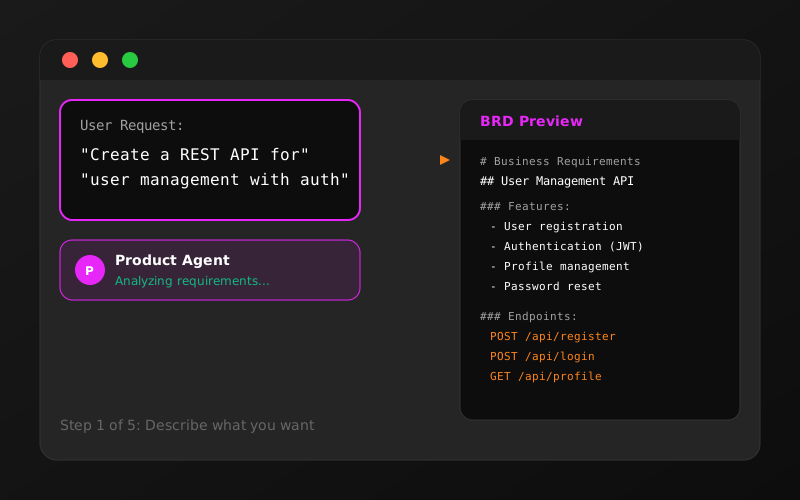
Describe your idea
Tell Product what you want in your own words. Product studies best practices and turns it into a Business Requirement (BR) — no massive specs to write yourself.
 Copula
 Six specialized agent roles, model-split orchestration, cross-repo parallelism with cross-verification — all on your infrastructure. Your code never leaves.
curl -fsSL https://get.copul4.com/install | bash A set of teams optimized and tailored for specific tasks, achieving high efficiency, speed, and low request costs.
Six specialized agent roles for iterative product development — Product, RnD, Developer, QA, DevOps, and optional E2E.
Global hub for all teams for cross-team interactions and automations.
Team for setting up dev/stage/prod environments, real-device testing, and release automation.
Team for market research, trends analysis, and trending content generation (video, audio, text).
Six specialized roles working as one dev team — with model-split orchestration that keeps cost down and quality up.
Your interface to the team
Turns your idea into a Business Requirement (BR). Studies best practices and expands what you describe into a clear, detailed brief the rest of the team can act on.
Vision and decomposition
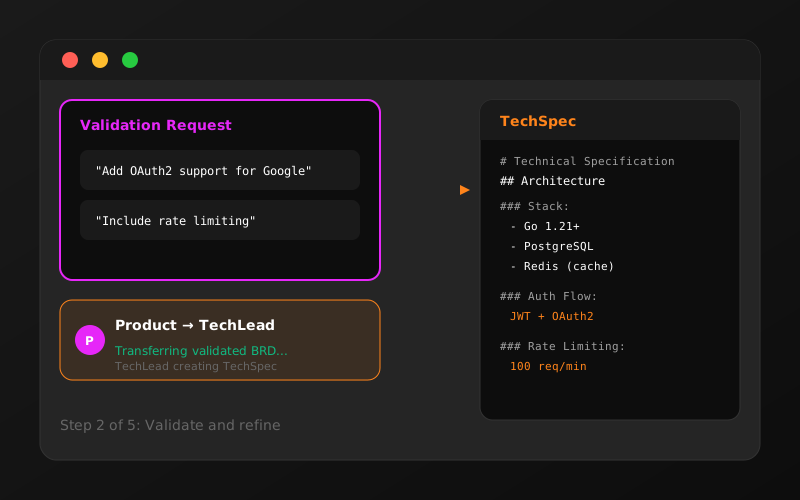
Takes the BR and produces a Vision & Scope (V&S), then deterministically decomposes it into concrete jobs the rest of the team can execute.
Writes the code
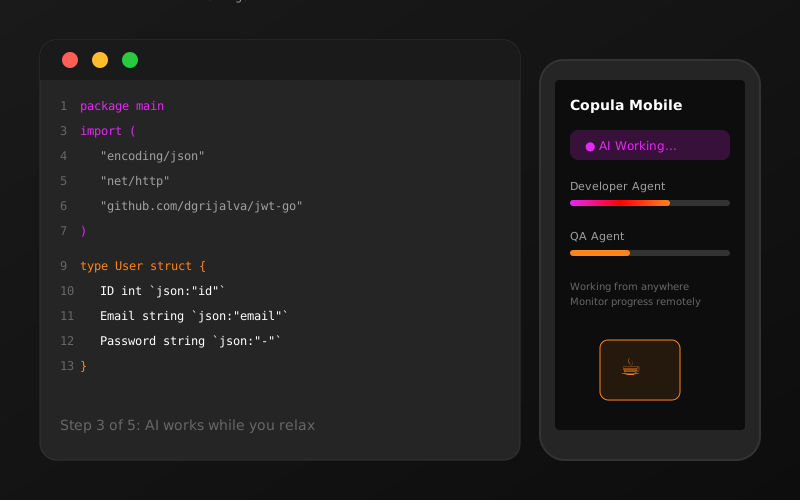
Implements each job end-to-end: edits files, runs tools, runs the build, and merges the result to git. Cheap models do the heavy lifting; the harder decisions stay with smart ones.
Verifies the work
Builds, runs tests, validates completion criteria. Cross-checks the Developer's output and retries with backoff until the job is done or escalated to you.
Deploy and infrastructure
Handles SSH access, deployment, and infrastructure. Ships the result to your servers so the work does not just sit in a branch.
End-to-end browser testing
Optional stage driven through Chrome DevTools MCP. Walks the real running UI, validates flows, and catches what unit tests miss.
From idea to merged code in five observable steps
Tell Product what you want in your own words. Product studies best practices and turns it into a Business Requirement (BR) — no massive specs to write yourself.
RnD converts the BR into a Vision & Scope (V&S), then deterministically decomposes it into discrete jobs the rest of the team can pick up and execute.
Developer implements each job end-to-end: edits files, runs tools, runs the build, and commits the result back to git. You can keep working from anywhere while this happens.
QA runs the build, the tests, and the completion criteria, cross-checking the Developer's work. Failed checks retry with backoff — up to three attempts before escalation to you.
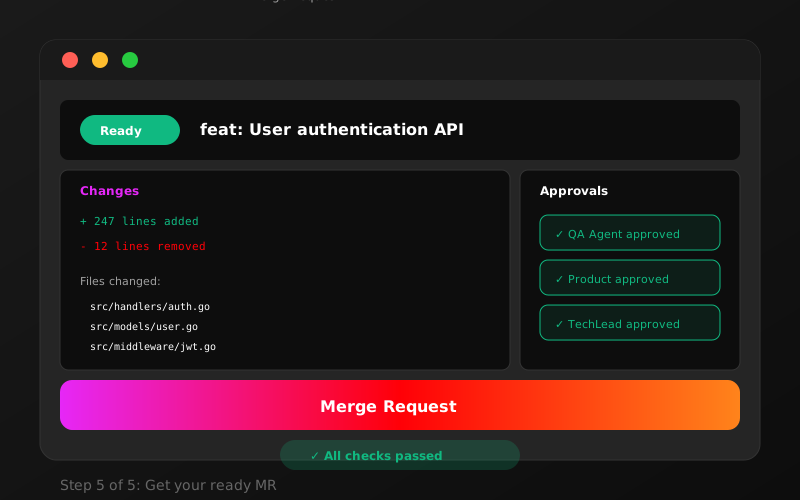
When QA signs off, the change ships. DevOps handles the merge and deploy on your servers, and E2E runs through Chrome DevTools MCP for live UI verification when you want it.
Why orchestration and verification beat one big agent
Specialized roles keep each agent's context tight, so the whole pipeline uses dramatically fewer tokens than a single-agent end-to-end run.
Smart, expensive models handle the head (Product, RnD); cheap, fast models handle the hands (Developer, QA). You get top-model quality without the top-model bill.
Jobs run in parallel across multiple repositories. Each repository's technical overview is regenerated automatically so context stays in sync without manual upkeep.
Agents find what they need by meaning, not by filename — across your entire codebase, your artifacts, and your session history.
Runs entirely on your infrastructure. Your code, prompts, and outputs never leave your servers, and you can audit every step.
See why Copula dominates in speed, cost, and quality
Features per month
Lower multiplier is better
On standard models
Iterative rework, bureaucratic chaos
Errors, manual fixes required
Agents cross-verify and 'tune' each other, significantly improving solution quality
Most AI coding tools ship you a single agent. Copula ships you a self-hosted team with model-split orchestration, cross-repo parallelism, and cross-verification.
| Feature | Copula | GitHub Copilot | Cursor | Claude Code | Devin | OpenClaw |
|---|---|---|---|---|---|---|
| Full team of specialized roles | ✗ | ✗ | ✗ | ✗ | ✗ | |
| Self-hosted (code never leaves your servers) | ✗ | ✗ | ✗ | ✗ | ✗ | |
| Model split for cost and quality | ✗ | — | — | ✗ | ✗ | |
| Cross-repo parallel execution | ✗ | — | ✗ | ✗ | ✗ | |
| Cross-agent verification with retry | ✗ | ✗ | ✗ | — | ✗ | |
| Provider-agnostic (any tool-capable model) | — | — | — | — |
What actually powers Copula — beyond the agent team itself.
Chrome DevTools, SSH, files, archives, web search — agents call them through a unified Model Context Protocol layer so each role stays focused on its job.
Business Requirements and Vision & Scope live as versioned artifacts. Every iteration references them, so decisions stay traceable end-to-end.
Every job moves through planning, pending, in_progress, done or failed. You see the live board at any moment.
Token spend, cost, savings, the file-change tree, trends over time, per-agent productivity — all surfaced, all exportable.
Agents push to your servers via SSH. No SaaS dependency, no proxy — your infrastructure stays yours.
Each role keeps its own memory across sessions, so context carries forward instead of restarting every run.
Three simple steps to get started
Open terminal on your computer or connect to VPS (Terminal on macOS/Linux, WSL on Windows)
curl -fsSL https://get.copul4.com/install | bash Set password for admin and api keys for models
Copula is installed and ready to use. Open Copula in browser via link from terminal
Currently in beta testing
Full access to all features during beta testing
For individual developers
For organizations with special requirements
Everything you need to know about Copula
Copula is a platform of ready-made, optimized AI agent teams for specific tasks. Each team has a wide range of tools to professionally perform concrete tasks. Currently in beta: DevTeam (development team).
Copula provides complete AI teams (not just single agents) that work together seamlessly. We offer up to 20x fewer tokens than OpenClaw, real-time transparency, cost analytics, permanent session history, and 100% code privacy - your code never leaves your machine.
DevTeam is available now in beta, with six specialized roles: Product, RnD, Developer, QA, DevOps, and optional E2E. Coming later: Nexus (Q4 2026), Delivery Team (Q4 2026), and Marketing Team (Q1 2027).
Simply sign up for free (no credit card required) and install with our one-liner command: curl -fsSL https://get.copul4.com/install
Still have questions?
Join beta testing and start developing faster
curl -fsSL https://get.copul4.com/install | bash